
In a fire, every second counts.
Research shows that the public does not always respond quickly to a conventional fire warning. We can all remember a time when we were unsure as to whether that ringing bell was ‘just a drill’ or even related to fire safety at all. It is that lack of message clarity, and the delays in action that come with it, that can cost lives. On top of that, where they do succeed in alerting the public, conventional sounders can often result in chaotic, panicked responses, further increasing the risk of casualties.
So, what’s the solution?
Where conventional sounders simply emit an alert tone, Voice Alarm systems provide clear, spoken instructions to occupants. This has proven to be much more effective in facilitating quick, efficient emergency responses, with intelligible speech messages like “please proceed to Fire Exit A” eliminating any guesswork. The benefits of this are manifold, at once reducing panic and confusion and cutting down occupants’ response times, both of which are vital to a successful evacuation.
A core advantage of Voice Alarm systems is the flexibility of their broadcasting, which can be configured to deliver messages in 3 primary ways:
-
- Individual Call: Allows for messages to be broadcasted to a specific room, floor, or zone, so that specific instructions can be sent to a limited area.
-
- Group Call: Enables operators to broadcast a message to a targeted group of zones, allowing for tailored communication to a specific area of a site.
-
- All Call: Used during full-site announcements and evacuations, this function simultaneously sends a message to every connected loudspeaker.
These messages can be pre-recorded or live – with emergency microphones taking priority over all other audio sources – which allows for live information to be shared as a situation develops. It also enables emergency services to direct operations upon arrival, dramatically improving the speed, safety, and control of an evacuation.
Where are Voice Alarm systems required?
As guided by BS 5839-8:2023, the current British Standard for fire detection and alarm systems, Voice Alarm systems are recommended in:
-
- High-rise buildings (6+ storeys). This includes:
-
- Public buildings
-
- Office buildings
-
- Residential buildings
-
- Hotels
-
- High-rise buildings (6+ storeys). This includes:
-
- Retail, commercial, and exhibition buildings
-
- Hospitals and health facilities
-
- Entertainment and sports facilities
-
- Cinemas and theatres
-
- Metros and underground rail stations
-
- Airports
Why are Voice Alarm systems recommended in large buildings?
Voice Alarm systems are generally recommended in complex and high-rise buildings because of their ability to broadcast messages to a specific zone or area. This is crucial when enacting a phased evacuation, which is widely considered to be the safest, most practical evacuation strategy for large buildings.
Essentially, it involves the staggering of an evacuation into stages, prioritising those in the most immediate danger. With a Voice Alarm system, a phased evacuation would look something like the following:
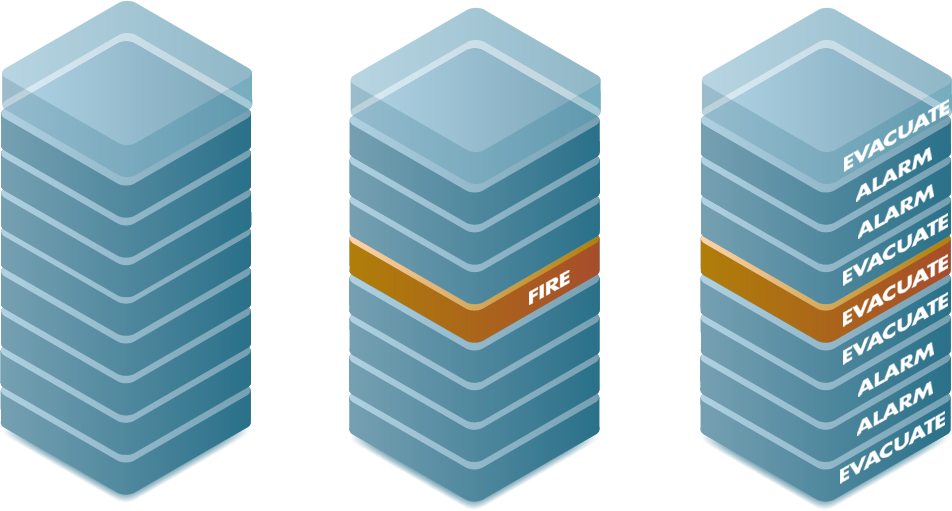
An Evacuation message is broadcast to the site of the fire and those floors immediately above or below it, while the remaining floors receive an Alert message. If the emergency escalates, the floors on Alert are evacuated in turn. This reduces congestion at bottlenecks, such as stairwells and exit points, thereby keeping evacuation as streamlined and safe as possible.
The Key Benefits of a Voice Alarm System:
-
- Provide clear instructions
-
- Induce faster responses from occupants
-
- Reduce panic by clarifying and directing the situation
-
- Support effective crowd management and phased evacuations
-
- Enable real-time emergency communication with context specific information
-
- Can be used emergency services to direct operations